|
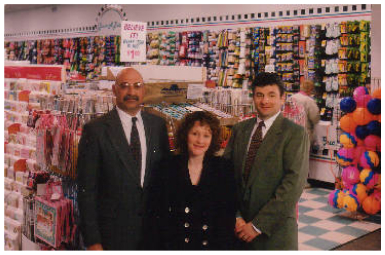
Meet Some of the Just-A-Buck Franchise Family
|
|
|
Eileen Caccavone and Jan Pitman met at Exxon conventions. Their
husbands, Jimmy (Caccavone) and Harry (Pitman), each owned service
stations in New York's Hudson Valley region. Eileen and Jan sometimes
helped out at the stations...other than that, they had very little
work experience.
|
|
Actually, to say that they had very little work experience
would be an exaggeration - Eileen never had a job...and Jan had
some experience in retail before having children.
|
|
Back in the 1980s they were both full-time moms. In the
early 1990s, when they were ready to start a business, their
friendship was ready to blossom into a solid partnership.
|
|
Their lack of experience made them an unlikely bet for
success...and compounding the odds against them was their choice
for a business venture - a franchise from a new dollar store
chain that had no other franchises up and running. Plus, it was
hardly the best-of-times for dollar stores. Competition was tough
and many chains were closing.
|
"They were completely honest and open with us about
every aspect of the business."
|
|
Just-A-buck's founders felt the chain could survive and
prosper even in the lean times if each store maintained quality
merchandise, operations, and service. But it was difficult to find
managers who were sufficiently motivated to follow the concept to
the letter.
|
|
Eileen and Jan needed the franchise relationship, and
Just-A-Buck needed highly motivated entrepreneurs. It was a
win/win proposition.
|
|
"What sold us on Just-A-Buck was Steve, Rochelle, and Bob,"
says Pitman. "They were completely honest and open with us about
every aspect of the business."
|
|
They opened their first Just-A-Buck in Vails Gate, New York,
in a busy shopping center.
|
|
Today they own five stores in New York's Hudson Valley region.
Each one consistently ranks in the top ten on the chain's weekly list
of highest average sales per customer. And as for their husbands,
they've sold their service stations and have gone into business with
their wives.
|
|
|
|
Usually when a woman returns to work after raising a family,
it's at an entry level position...but when Kwan Hakim, owner of a
Just-A-Buck franchise in Memphis, Tennessee, decided to go back
into business, she wanted to be the boss and didn't want to wait.
|
"When I look back on things today, I realize I could
never have made it without the franchise relationship."
|
|
Kwan came to the United States in the 1970s on a full
scholarship to study communications at the University of Memphis.
After graduating, she became a TV assistant operations manager.
She held the same job for 13 years. "back then it was difficult
for a woman to have a family and a career too," Kwan remembers.
|
|
This time it would be different. Sure she would still work
long and hard...but not for someone else. She was in search of the
American Dream. Franchising would be the answer...for her, her
family, and her extended family as well.
|
|
She researched many different methods of running a dollar
store. She considered being an independent operator. After all,
she had plenty of contacts in Hong Kong. She also considered
buying a business opportunity...but she had difficulty researching
the officers' background.
|
|
She learned that business opportunity licensees are not
regulated as strictly as franchises. Nor are there trade organizations
representing this business group. When she met the founders of
Just-A-Buck she felt confident that they would have her best
interest in mind. They were young and needed every franchisee to
succeed.
|
|
"When I look back on things today, I realize I could never
have made it without the franchise relationship. Not only did they
help regularly with purchasing, they also helped me promote my
store."
|
|
Today Kwan is a spokesperson for the International Franchise
Association on opportunities available in franchising for women
and minorities.
|
|
|
|
Imagine how difficult it is to come to this country
with the hopes of getting a decent paying job in corporate
America - especially when language is a difficulty. Many
people who would have held professional positions in their
native lands are forced to find jobs that pay little and
demand a lot of hard work.
|
|
Some new arrivals invest their savings in businesses
like taxi medallions. They are, therefore, forced to live in
cities where life is difficult and expensive. What's more,
just at the time when the family needs emotional support,
the wage earner must spend long hours away from home.
|
|
A Just-A-Buck store can be opened in a large city...or
in small town...wherever the owners choose to live. That's why
an increasing number of foreign-born residents are finding
that a proven successful franchise like Just-A-Buck can
be the beginning of "The American Dream."
|
|
When Moe Al-Quadah and his cousin Cal Al-Quadah came to America
in 1988, they didn't want to waste time in entry level positions.
Initially they worked at service stations and convenience stores.
Eventually they purchased a number of these outlets.
|
|
They liked the dollar store concept. After meeting the founders
and talking to a number of franchisees, they opened their first
Just-A-Buck in Garnerville, New York. The store is 3,750 square feet
and is located in a strip mall where parking is convenient. Soon
the partners purchased a second location, this time in an indoor
mall in Edison, New Jersey.
|
...an increasing number of foreign-born residents
are finding that a proven successful franchise like
Just-A-Buck can be the beginning of "The American
Dream."
|
|
They quickly learned that each Just-A-Buck store has
an entirely different character and often caters to completely
different customers. The customers who shopped at the enclosed
mall bought different kinds of merchandise than those who came
to the strip center.
|
|
Through the purchasing department at Just-A-Buck, they
were able to identify their customers and buy items to fill
their needs. Today the partners are in the market for another
store.
|